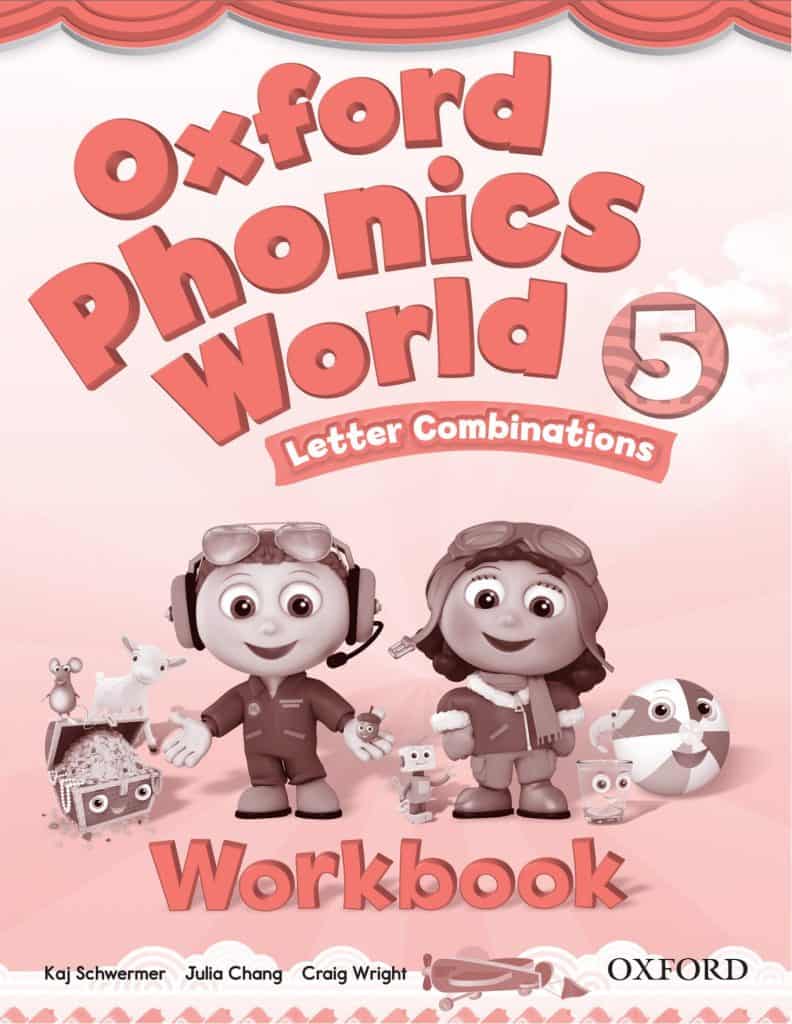
About This Book
Oxford Phonics World Workbook 5 is the fifth workbook of the Oxford Phonics World course. The destination page is headed ‘Oxford Phonics World 5 Workbook’, in the host’s word order, with the site’s free-download suffix, and the file it serves, ‘Oxford Phonics World 5 Workbook.pdf’, carries the same course, level and workbook in the host’s word order — the same volume under the filename the site serves it by. The book’s work is the system’s completion: the whole phonics map exercised as one instrument, certifying the code in the reader who finishes it.
There is a quiet grandeur in a final workbook, because its subject is not any single pattern but the reader the previous four built. Workbook 5’s pages mix everything the course taught — singles, blends, families, variants, renegades — in the proportions print actually uses, which is the definition of a graduation: the exercises stop being about the system and start being the world, lightly disguised. A child finishing this volume has something no later schooling can take back, because decoding owned entire becomes invisible infrastructure: every subject, sign, screen, and story for the rest of their life will run on it silently. Teachers certifying at this level are entitled to a moment of professional awe — the code that arrived as sounds on a carpet in Workbook 1’s year now reads chapter books unaided — and the workbook’s last pages, finished, are the signature on that transformation. Parents shelving the set should know what the five spines represent: the complete manufacture of a reader, in paperback instalments.
What Learners Will Practise
The System, Mixed
Learners practise the whole map in print’s own proportions — patterns arriving unsorted, as books present them. Mixture is the graduation standard; sorted practice was the scaffolding.
Speed as By-Product
The book practises fluent pace that emerges from architecture rather than effort. Forced speed collapses; surveyed speed compounds.
Reading Anything
Readers practise applying the code to unpractised material — the transfer test. A code that only works in its own workbook was a course, not a competence.
Key Features
The integrated mixture is the feature: the world, lightly disguised as exercises. The invisibility standard is the second — decoding as silent infrastructure — and the shelf fit the third, the completion beside this list’s fourth workbook and the grammar worksheet. On this shelf it completes the code here.
Who This Book Is For
Graduating decoders at the course’s summit are its first audience. Teachers form its second readership, certifying the code complete. Parents make its third, shelving the manufactured reader’s paper trail.
How to Use This Book
Finish with unpractised texts weekly; transfer is the certificate, not the last page. Let the graduate read aloud to a younger child once — teaching is graduation’s public form. Keep the five workbooks; few school artefacts document a transformation this completely.
Related Books
The fourth workbook stands at Oxford Phonics World Workbook 4, and the first grammar worksheet at Smart English Grammar Worksheet 1.